Monday, March 25, 2019

Spotted Salamanders


          A friend and I recently took a walk in the woods to look for salamander eggs in the vernal pools.  In one pool we hit the jackpot...69 spotted salamander egg masses!

          Vernal pools are important habitats for various frogs, toads, salamanders and plants. You can often find a vernal pool by following the early spring sounds of frogs. These sites are unique in that they are seasonal.  They dry up after spring time.  Because they are seasonal, there are no fish in vernal pools, making them ideal nurseries for creatures that rely on them for breeding. 

          Salamanders return to the same pool where their life began when it is time to breed and reproduce.  Adults can live up to twenty or more years, usually close to the vernal pool they came from. In summer adults are usually hidden under leaf litter or logs, where they eat centipedes, worms, spiders, crickets and slugs. In winter they live underground.

Vernal pools are shallow and dry up by summer time. 


An egg mass contains about 100 eggs
 

An adult spotted salamander can reach  6 to 10 inches in length.  The spotted salamander is the official state amphibian in South Carolina and Ohio. Photo courtesy of Diane Girgente.

Sunday, March 24, 2019

Spring Ephemerals


          Spring ephemerals are the early wildflowers with a short life cycle.  They must emerge from the ground in their woodland habitat, bloom quickly and then set seed before the tree leaves emerge in the canopy above and block their access to sunlight.

          Here are a few ephemerals I found today.


Spring Beauty, Claytonia virginica


Hepatica, Hepatic acutiloba
 

Mayapple, Podophyllum peltatum, just  emerging. In a few weeks the nodding white flower will appear beneath its leaves.

Bloodroot, Sanguinaria canadensis.  The red sap in the roots was used as paint and dye by Native Americans.


Toothwort, Dentaria laciniata.  The leaves are edible.

  
A Comma butterfly is nectaring on this Saxifrage, Saxifraga virginiensis


Common Blue Violet, Viola sorois.  The seed coat contains a bit of food so ants carry the seeds to their colony, eat the food and discard the intact seed, thereby planting it.  Think "ant farming!"


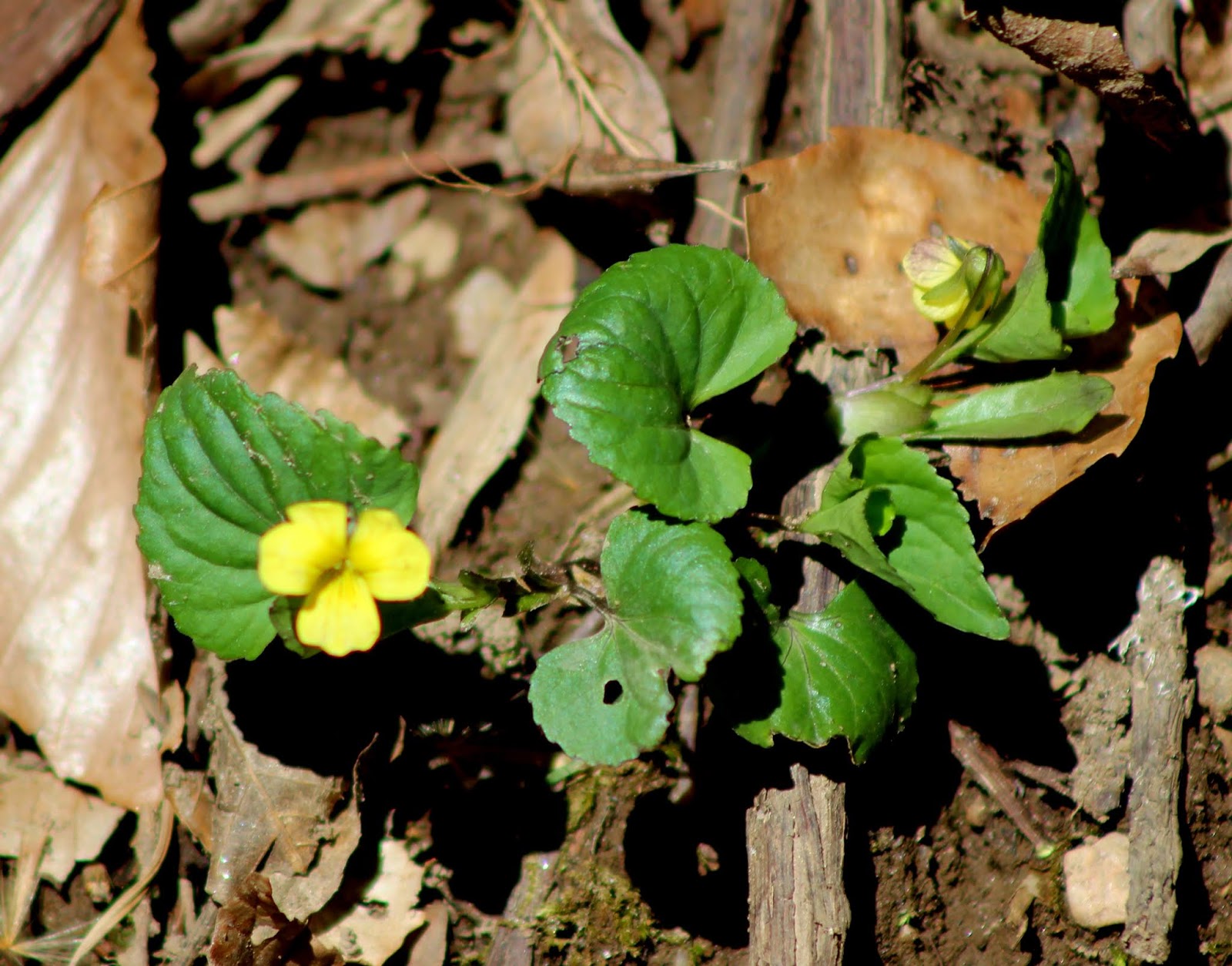
Woodland Violet, Viola pubescens.

Friday, August 24, 2018

Eastern Black Swallowtails: A New Generation


           For several years I have planted  fennel as a host plant for the Easter Black Swallowtail Butterflies to lay eggs on.  Fennel, dill, parsley and Queen Anne's Lace are the host plants that feed black swallowtail caterpillars,  so that is where the female butterfly lays her eggs.  For several years my cannas outcompeted the fennel for space in the garden so the fennel's growth was limited.  This year, however, the cannas didn't come back and the fennel grew to six feet tall.  That's when I noticed caterpillars, lots and lots of caterpillars.  In fact, there were so many caterpillars that there isn't much fennel left.


The caterpillars's job is to eat and grow until it is time to pupate.


The chrysalis, where metamorphosis takes place.


Adult Eastern Black Swallowtail -- male.
  
 
To see the Monarch Butterfly life cycle, and photos of a butterfly emerging from the chrysalis, see my post dated September 29, 2016, called Miracle of Monarchs.                                                                                   


Tuesday, July 24, 2018

Oh Those Fun Amphibians


           Most toads are nocturnal and like to hunt insects at night. These two Fowler's Toads seem to have found a shady toad abode to pass a hot summer day.


           This Grey Tree Frog chose a perfect window perch for catching insects... and apparently watching television since this is the only window I see him in at night and it is directly across from my TV.

          Frogs and toads are both amphibians.  Toads have bumpier skin than frogs.  Frogs prefer wet habitats near water while toads typically prefer dry land.  Both lay eggs in the water.  Toad eggs appear in long chains while frog eggs are in gelatinous clusters.  We have 28 species of frogs and toads in Virginia.

Sunday, May 6, 2018

An Amazing Collection of Azaleas


          A generous family donated their 79-acre property in Hanover County to Lewis Ginter Botanical Garden.  It is called the Lewis Ginter Nature Preserve. The estate features an impressive azalea collection of more than 1,600 varieties. In addition to azaleas, there are huge trees, dogwoods and beautiful rhododendrons.  Recently, I was fortunate to visit the property with the Virginia Landscape Design Consultants Council while the azaleas and dogwoods were in bloom. And thankfully, I had my camera.

          Unlike my spontanious gardening style  (there's a plant sale!), this family worked professionally and methodically for many years.  Not only is every plant labeled, but a database was established to record all the azaleas. Strolling through the garden, you see names such as Prosperity, Kagetsu, Marian Lee and Koromo Shikibu.  When combined with Lewis Ginter Botanical Garden's own azalea database, this puts Richmond near the top among significant azalea gardens in the U.S. 

          Besides a gift of a garden that is beautiful and timeless,  it is also one that is exact and recorded.  What a labor of love. What a gift. Thank you to the family for this gift of a lifetime.


Friday, May 4, 2018

Tulips To Make Your Heart Sing

          Tulips are such a joyful sign of spring.  You don't have to visit Holland to see masses of beautiful tulips, just visit Lewis Ginter Botanical Garden in mid to late April.  The Garden celebrates A Million Blooms, and this is what it looks like:


Sunday, November 19, 2017

. . . And BEARS! Oh My!


My Friend Rebecca, who lives near a state park, spotted this young
bear in her driveway in Powhatan.

Forget movie stars or super models…the absolute coolest woman I ever met is Katie Martin.  Martin is a wildlife biologist who WORKS WITH BEARS!  I grew up at a time when careers for women were in teaching and nursing, so I was in awe of Martin when she spoke, from experience, to James River Master Naturalists about black bears in Virginia.

Martin’s job with the Virginia Department of Game and Inland Fisheries goes beyond educating the public to avoid conflicts with bears.  She also traps bears to fit them with GPS collars for research, and finds foster mothers for orphaned cubs. 
 
Biologist Katie Martin shows a GPS bear collar.
 

The Bear Facts

According to Martin, bears are intelligent and inquisitive.  Females, or sows, can grow up to 250 pounds, or more, while males, called boars, average 250 to 350 pounds, but can weight even more.  Bears see in color but have poor vision.  However, their sense of smell is seven times greater than a bloodhound’s. 

Bears are usually shy, solitary creatures that are driven by their stomachs, explained Martin.  Their main focus is food.  As omnivores and opportunistic feeders, a bear’s diet is 75 percent vegetarian, consisting of acorns and nuts, wild grapes, berries such as poke berries, fruit, grasses and plants. The rest of its diet consists of insects and larvae, carrion, small mammals, fish, amphibians and termite grubs.  As opportunistic feeders, a bear will take advantage of bird feeders, pet food, livestock feed and garbage. 

Female bears become sexually mature around three years of age and only give birth every other year.   After mating in summer, she bulks up on food before hibernating around November.   Then, she gives birth to two to four cubs around January and they will emerge from the den in springtime.  The cubs will remain with her for more than a year.

Males do not hibernate but are less active in winter.  They may bed down for a while and roam or forage when temperatures warm up to the sixties.

Foster Cubs

When a sow is killed by a car or hunters, young cubs were once taken to a wildlife facility until they were old enough to be relocated.  As adults they faced a high mortality rate because not only were they suddenly placed in unfamiliar territory, they lacked a mother to teach them the ways of the wild.  Martin is now involved in a new plan for raising orphan cubs.  She places them with another mother bear that already has cubs.  Sometimes this means slipping them into the den of a hibernating sow that will then raise them along with her own cubs.  It may be a lot of extra mouths to feed, but a mother bear is very nurturing and willing to carry the extra load.  This fostering program has been successful thus far.   GPS collars help locate the den sites.

A Fed Bear is a Dead Bear

Martin educates the public and works with landowners or communities to reduce and avoid bear conflicts.  When bears are spotted in a neighborhood she advises homeowners to remove any potential food source.  Bears tend to roam in search of food and do not spend time in one place if food isn’t available.  She advises homeowners to remove bird feeders from April 1 to December 1.  Also, homeowners should avoid feeding pets outdoors or inside near a doggie door.  Remove ripe fruit from trees or the ground.  Make sure your grill is clean and free of leftover food.  Keep trash cans latched. Electric fences are effective ways to keep bears from orchards, gardens or bee hives.  If no food is available in your yard, a hungry bear will move on in search of food elsewhere.

After finding empty feeders scattered and broken, and the metal pole
bent in half, I removed my feeders for a while.
 

Bear Sightings

If you encounter a bear, stay calm and slowly back away.  Do not run and tempt it to give chase.  If hiking with others, stay together and make noise.  Keep your dog leashed at all times.  A bear suddenly approached by a barking dog can become defensive and dangerous.  Carry bear spray in remote areas.

The Virginia Department of Game and Inland Fisheries, DGIF, has useful information and interesting videos on their website about living with black bears in Virginia.  www.DGIF.virginia.govLearn about the right closure for trash cans, how to deter and prevent bear encounters, and safety tips.  And if you do have bear problems, contact Katie Martin.  She knows EVERYTHING about bears!
 
Although Rebecca's birdfeeder is electrified, "Smokey"
made several attempts to empty it before giving up
and walking away.