Wednesday, January 11, 2017

Daffodils Mean Springtime


                                    “…And then my heart with pleasure fills
                                       And dances with the daffodils.”     ---William Wordsworth
 
           Daffodils mean springtime in Virginia.  Varieties such as “Early Sensation” begin to bloom in late February, but most daffodils bloom in mid March and early April, depending on the weather.  Growing daffodils is easier than any other gardening I can think of.  And, in most cases, the results will last forever.  Plant once and they will bloom year after year.  Even if you have never tried gardening before, you can grow daffodils.  And unlike tulips, deer won’t eat them.
           We are fortunate to have a bulb supplier right here in Virginia.  Brent and Becky’s is an internationally-known bulb farm located in Glouster.  If you can’t make it to Holland to see the tulips and spring bulbs in bloom, a trip to Brent and Becky’s store is the next best thing.  The garden shop is a delight, but you will be amazed as soon as you pull into the parking lot and find yourself surrounded by thousands of colorful blooms.  The bulbs they offer in their beautiful catalog are in full bloom all around you.  Bring your camera.  And plan to spend most of the day. 
 
The Glouster Daffodil Festival is April 1 and 2.
 
 
Here are a few photos taken at Brent and Becky's retail shop.


Thursday, December 8, 2016

Inspired by Nature -- Christmas at Belmead


           Armed with tool boxes, branches, pinecones, ribbon and ladders, a group of Salisbury Garden Club volunteers transformed the 1800s Belmead mansion into a winter wonderland for Belmead's annual concert fundraiser for the Powhatan Free Health Clinic. " Inspired by Nature -- Christmas at Belmead" was the theme created to incorporate greenery and natural elements from the property for decorating.  The group used gourds, osage oranges, pinecones, seed pods and more in their beautiful designs.
\


Repurposing Can-Do


            What can you do with a leaky watering can?  My clever neighbor hung several watering cans and planters of flowers in a tree.  The result was interesting and whimsical.  And, I bet next spring some of those cans will make wonderful homes for nesting birds.  If you have a leaky watering can, don't throw it away.  Hang it from a tree branch, or on your porch.  Better still, hang it above a hanging basket of flowers!


Tuesday, December 6, 2016

From Dump to Devine -- A Labor of Love


Some people retire to a life of travel or leisure, but Bernice and Armand Thieblot retired to a life of labor.  They began a mammoth, labor intensive project to restore a piece of land in Schuyler, Virginia, that was once a quarry and a dump site.  They bought nearly 600 acres and after many years of hard work, will open a 40-acre botanical garden next April – The Quarry Gardens at Schuyler. 

 The property they purchased in 1991 had once been owned by a soapstone company and several quarries are located on the site.  When the quarry company closed in the seventies, it allowed residents to use the site as a public dump for twenty years.  This means the Thieblots had to remove mountains of washers, dryers, refrigerators, tires, trash and debris to begin the land restoration process.  After visiting Butchart Gardens in British Columbia, which was built on an old cement quarry, the Thieblots were inspired to restore the land around the quarries on their property for a public garden.  Instead of formal gardens, their focus is on native plants.  

Soapstone was the major industry in Nelson County in the late 1800s and early 1900s. Virginia was considered the “soapstone capital of the world.” One company employed more than 2,000 people. Ninety pits were quarried in the area.  Resistant to acids and bases, soapstone was used in commercial labs and school science labs.  Since it holds heat and water, it was also used for fireplace surrounds and laundry tubs. 

The land around the soapstone sites is unique—the alkaline soil is rich in minerals that support a variety of plant communities.  So far 500 species of native plants have been identified in the gardens.  The couple  planted 18 thousand native plant plugs during the restoration process. And like most land in the state, removing invasive species is a never ending battle. 

Bridges, a viewing area and walking trails have been created to make The Quarry Gardens at Schuyler easily accessible.  The visitors center will feature a classroom and a shop.  For information, visit www.quarrygardensatschuyler.org.

Thursday, September 29, 2016

Miracle of Monarchs


          Normally I don't interact with monarchs.  I provide plenty of nectar flowers and a lot of milkweek, mostly swamp milkweed (incarnata).   However, by the middle of September, I walk around checking milkweed, and at some point most of the leaves have been eaten and there's nothing left but stems with only a leaf or two.  But there are still monarch caterpillars on the stems, which is fine for the larger caterpillars but the tiny new ones need leaves.  And then the unthinkable happens...along comes a monarch to lay another egg on what has become milkweed scraps.  At this time I am compelled to take action.  I will buy milkweed or cut milkweed from the roadside and put it in a vase of water. The mom instinct kicks in and I have to provide for the season's last caterpillars. 

         Fortunately this year my nursery had six large, scraggly milkweed plants available for sale.  Since it was so late in the season, they were missing quite a few leaves and were filled with seed pods so I got them for half price.  I would have paid double if necessary so that I could re-balance the caterpillar to milkweed ratio at my house.  End of season milkweed is better than no milkweed, if you are a monarch caterpillar.  I brought home the plants, watered them and put them by my side door.  Then using scissors, I snipped a bit of stem containing a caterpillar and relocated it to the new milkweed.  I don't mind touching them but I think it may be better for them if I don't. 

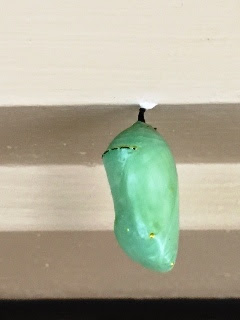
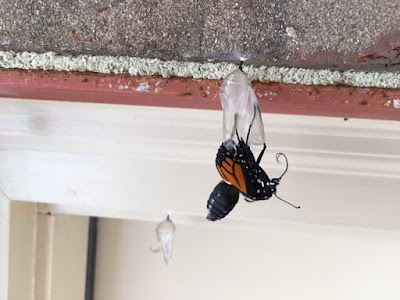
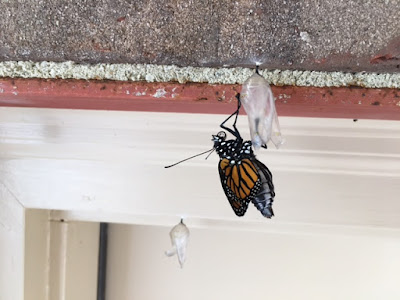
     Finally the six new plants were full of caterpillars of various sizes doing what caterpillars do best, eating and pooping.  Within a day or two, several crawled up the porch to the doorway and porch eaves and pupated.  Beautiful green chrysalises began popping up everywhere as caterpillar numbers finally began to decline.  Once the green chrysalis turns clear, the butterfly soon emerges.  I was lucky to catch one on camera but the others disappeared one by one, leaving an empty chrysalis hanging on my porch. 

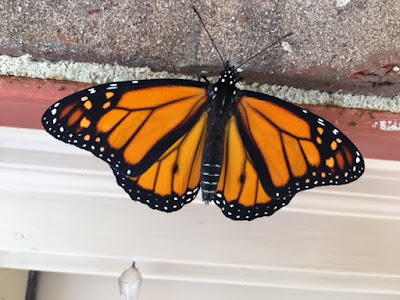
         Not all of there caterpillars would be successful.  I don't know how many pupated in the yard on their own before I got involved.  I collected and relocated about 16 caterpillars which pupated.  I found one chrysalis blackened, opened and empty, a victim of some predator.  Two turned black and never eclosed, due to predatory wasps or perhaps the OE disease.  One emerged but I later found pieces of wings on the porch steps. I don't know who got the body.   But at least a dozen or more made it.  I watched some of them dry their wings and begin their flight to Mexico. 

         I have four fat caterpillars and a few milkweed leaves left.  One of the caterpillars today is hanging upside down in a J shape so I expect to see a chrysalis there tomorrow. 

          It was so moving to see a chrysalis crack open, watch a leg come out, followed by the rest of the butterfly.  It was a miraculous birth.  I could not contain my joy.  I sent photos to friends and family and everyone I have ever known.  Nature gives us amazing miracles every day.  We have to look carefully to find them. 

Caterpillars are eating machines, growing and shedding their skin four or five times.

The chrysalis is green for about 10 days and then turns clear.

The chrysalis breaks easily.


The proboscis is in two parts and has to be fused in to one straw-like piece for sipping nectar.

The wings are wrinkled and folded and appear smaller than the body.

A butterfly can take several hours to stretch and pump fluid into its wings.


It's a boy!  And he is going to Mexico.

Tuesday, September 20, 2016

A Bounty of Butterflies


       Butterflies are my favorite part of summer.  If you plant nectar plants for them in the spring, they will begin to show up in early to mid summer.  It is important to plant en  masse, in full sun, and limit the use of herbicides and pesticides.  The best time to photograph butterflies is the hottest part of the day when they are most active.  On a sweltering day in August, I shot these butterflies in my flower garden and in my butterfly meadow. 


A Red  Admiral
 
An Eastern Comma
 
A male Eastern Tiger Swallowtail
 
Monarchs arrive late July and August
 
I saw lots of Hackberry Emperiors this summer.
 
The Great Spangled Fritillary is a large butterfly.
 
A Spicebush Swallowtail
 
Zebra Swallowtail
 
Eastern Tiger Swallowtail, dimorphic (dark) form.
 
A small Silvery Checkerspot
 
A two-for-one photo. Coneflower is a great butterfly plant.
 
Not a butterfly -- a Hummingbird Moth.