Sunday, September 20, 2015

Good bye Monarch Butterflies


           As the days grow cooler and less humid, the monarch caterpillar season seems to be winding down. I don’t see any caterpillars now.  Only a few chrysalises are left.   This morning I noticed one that was clear and it was easy to see the black and orange wing markings inside.  I expected it to open today but was surprised to see a butterfly had emerged by 10:30 a.m.  It stayed hanging from the empty chrysalis for more than two hours.  I kept checking it and when it was ready, I was there to watch it fly away.  I said a little prayer for its safety.   Now there is one chrysalis left and I think it will be empty in a few days.  I'd like to think that these late summer monarchs will be among the butterflies that successfully make the migration to Mexico. 
This new chrysalis is bright green.  The skin the caterpillar shed before pupating is still visible at the top.


Just before the butterfly emerges, the chrysalis becomes clear and the wings are visible inside.


The newly emerged butterfly, holding to the chrysalis case,  must stretch and dry its wings before flight.

The empty case.


Monday, August 31, 2015

Hey Neighbor, Can I Borrow a Cup of Milk . . . Weed?


            This year I have a bumper crop of monarch caterpillars.  Every milkweed plant is covered with them, and they are consuming all of my milkweed.  There are few leaves left on any of the plants and some have been stripped of all leaves and flowers.  The biggest caterpillars are eating the stems and even the seed pods, but the younger ones need leaves.  Each time I find a chrysalis, I think, “good, one less mouth to feed!”  Finally, I began calling neighbors asking if I could romp through their fields in search of milkweed.  I found a small patch in one neighbor’s field that hadn’t been mowed.  I cut one large stalk of the common milkweed, put it in water, and transferred a few caterpillars onto it.  Tomorrow I will cut another stem. 

           I thought I planted plenty but now I feel like a poor mother with too many mouths to feed and not enough food to go around. Adult butterflies only drink nectar from flowers, but caterpillars are eating machines.  As they eat and grow, they shed their skin about five times during the larval stage.  The time in between shedding is called an instar. 

           Actually, seeing lots of monarch caterpillars is good news because in the past 20 years the monarch population has decreased an estimated 90 percent. There are many reasons, including deforestation where they winter in Mexico, and loss of habitat, especially in the midwestern corn belt and wheat belt.   

           Survival is difficult but I am hopeful that some of my caterpillars will become the adult butterflies that will make it all the way to Mexico. 

Monarch Life Cycle

Egg – 3 or 4 days.  Monarch butterflies are host specific, laying their eggs only on milkweed plants.  A female can lay several hundred eggs in her short lifetime.

Larva/Caterpillar – 10 to 14 days. 

Pupa/Chrysalis – 10 to 14 days.

Adult/Butterfly – 2 to 5 weeks. The last generation that emerges at the end of summer will live 8 to 9 months and migrate to Mexico.


Competition is tough.


Older caterpillars are reduced to eating stems.


Some are even eating tough seed pods.


Next they pupate.


The chrysalis darkens before it is time for the butterfly to emerge.


Monday, August 17, 2015

Monarch Caterpillars -- At Last!


           I finally spotted a monarch in my yard about a week ago.  After disappointingly spotting a few viceroys several weeks earlier, I have been looking diligently for monarchs, and finally saw a female nectaring in my garden.  Both swamp milkweed (Asclepias incarnata) and blood flower milkweed (Asclepias curassavica) were nearby.  The monarch's wings were a bit ragged and her coloration was faded.  Adults only live a few weeks.  As I watched, she visited the milkweed, but not the flowers.  Instead, she landed on the leaves on the lower part of the plant. Butterflies can taste with their feet so  I suspected she was searcing for a place to lay eggs and today I discovered caterpillars!  I counted 5 caterpillars in various sizes and instars.

          Finding caterpillars prompted me to examing other milkweed plants around my yard and meadow, where I found several more caterpillars.   Naturally I also found lots of orange-colored aphids feeding on  the plants.  I squished as many as I could with my hands, wearing gardening gloves of course.  Aphids suck the juice out of the milkweed that the caterpillars need for food.  Monarchs only lay their eggs on milkweed, which is the sole food source for the caterpillars. 

          Milkweed contains toxins -- cardenolides.  Insects that eat the toxic milkweed taste bad to predators.  Although adult monarchs don't eat the plant, they still carry the toxins from the caterpillar stage to the adult stage.  The orange and black coloration of adult monarchs  is a warning sign to predators. 

          Milkweed plants support of lot of life.  I found several insects and butterflies nectaring on milkweed flowers.  More of the blood flower milkweeds are currently flowering right now than the swamp milkweeds.  Both varieties have produced seed pods already.  With seed pods, naturally I found milkweed beetles that feed on the pods as well as the plant.  There isn't much I'm willing to do about them.  They are too big for me to squish, and of course I can't spray insecticide on milkweed that the caterpillars are eating. 

          I have been monitoring milkweed pods in order to harvest seeds to plant next year.  The best way to do this is to check the pods regularly.  As soon as one splits a tiny bit, I know the seeds are ready to harvest.  If the pod opens fully, it is difficult to separate the seeds from the fluff that carries them through the air.  That fluff was once used in early flotation devices.  By opening the split pod further, I can hold one end of the white part where the fluff is still attached and simply scrape off the seeds, leaving the fluff intact and collecting clean seeds. 


A female monarch investigates a milkweed plant.


A monarch caterpillar feeding on milkweed.


Orange aphids feeding on milkweed.


Milkweed beetles feeding on seed pods.


Many butterflies sip nectar from milkweed.


A variety of insects nectar on milkweed.


A seed pod partially opened.


It is easier to harvest seeds if the pods aren't fully open.


The white fluff remains intacts, making seed collection easy.


Thursday, August 13, 2015

In Pursuit of Bugs


                  It was a perfect summer day when Entomologist and  County Extension Agent Dan Nortman led master naturalists on an insect survey in Powhatan.  Finding the most insects, and the most diverse insects, requires two things -- sunlight and native plants, Nortman explained.  Participants learned several methods for collecting insects.  Gently beating a low oak branch over a white sheet produced several specimens for the group to examine.  Insects captured were temporarily placed in plastic containers for a closer examination after the walk.

                Participants used sweep nets to collect insects from a sunny meadow.  This effort produced mayflies, ladybugs, bee mimics, leaf beetles, a few native bees, katydids, a bronze borer, soldier beetles and immature praying mantids.  Nortman uncovered a small froghopper nymph beneath its frothy spittlebug juice.

                Along one trail Nortman pointed out traces of leaf miner insects.  A larval insect crawls between the top and bottom layers of a leaf.  As the insect grows the trail on the leaf grows bigger.  It pupates inside the leaf and exits as a mature insect.  The plant may appear unsightly, but the insect doesn’t cause any harm.  Leaf miners may be moths, sawflies, flies or wasps. 

                We stopped at a creek and several members of the group collected macro invertebrates from the water.   Besides stirring up a few salamanders and crayfish, we were able to capture and examine stonefly and dragonfly larvae.

                Other interesting specimens were collected during the day.  One daring participant captured a wolf spider carrying dozens of its young on its back. Tiger beetles were spotted but evaded capture.  Rotted logs provided another source of insects for collection. All of the captured insects were released after examination.

                For those who interested in insect identification, Nortman recommended Kaufman Field Guide to Insects of North America. 

Using sweep nets to capture insects.

Transferring the catch into plastic containers.

A stonefly naiad with wing buds (left) and a mature stonefly with wings (right).


Wednesday, July 29, 2015

Eye on Nature

           Mother Nature often presents some unusual sights.  I am grateful when I have my camera to capture them.  Here are a few pictures of my recent summer sightings.


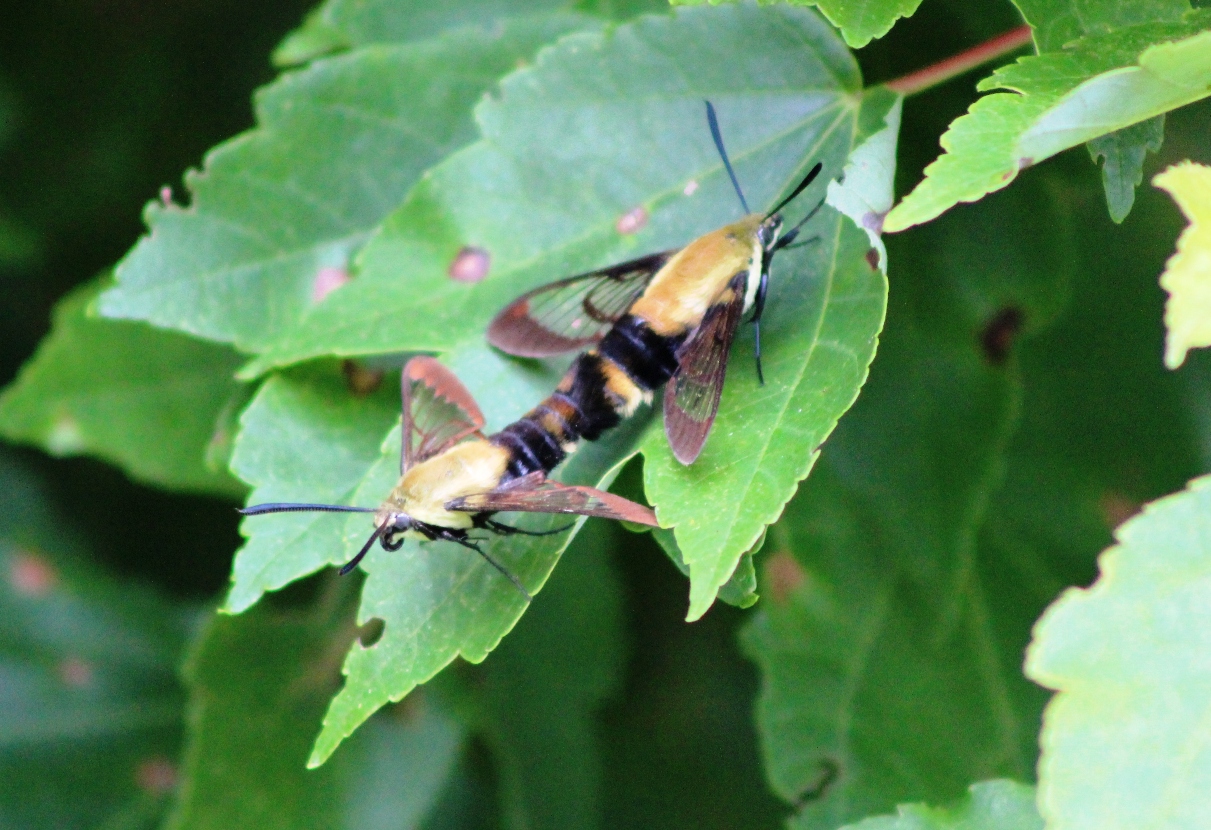
Hummingbird moths mating.


We have all seen tadpoles before, but in a bird bath, 20 inches off the ground?
 
With the exception of my tadpole bird bath, honey bees occupy every water source throughout my yard. Last time I found honey bees drinking water I discovered a swarm.  See Dec. 2, 2014 post.


A wheel bug consuming a Japanese beetle.  See Jan. 10 post for more wheel
bug information.

Ever seen a hummingbird's long tongue?  Many people assume they use their beak like a straw, but they actually lap nectar with their tongue, much like dogs lap water.
 
A plant gall.  Often caused by insects, most galls  are harmless to the plant.


Sunday, July 26, 2015

Counting Butterflies


               A large group of birders, naturalists, conservationists, photographers and other good people gathered for the Environmental Studies on the Piedmont’s 20th Annual Butterfly Count at the Clifton Farm Field Station in Warrenton, Virginia.  Several groups surveyed about ten different sites for the count, which contributes data to a nationwide study compiled by the North American Butterfly Association. 

                Local butterfly counts are a key component of a larger research effort to monitor  butterfly populations for changes that may be affected by weather, habitat change or other issues that impact the health of a butterfly species.  Sure, butterflies are pretty, help pollinate plants and are part of the food chain, but why are the numbers so important?  Twenty-two species in the U.S. are listed as threatened or endangered. The Xerces blue disappeared from California several years ago.  Last year two butterfly species in Florida were declared extinct by the U.S Fish and Wildlife Service.  The monarch population has decreased nearly 90% over a twenty year period.  Who knows, if we can save the butterflies, maybe we can save ourselves.
 
A dry, hot day in July was ideal for hunting butterflies.
 
Among the many butterflies and skippers we saw, there were plenty of tiger swallowtails.
 
We spotted a few red admirals.
 
Spicebusg swallowtails showed up for the count.
 

It was exciting to see some monarchs. 
 
Some participants tallied numbers and compared notes at the end of the day.

Monday, July 13, 2015

Butterfly Gardening -- Easy and Rewarding


Joe-Pye weed is a native plant and a butterfly favorite.


When you are purchasing plants for garden beds or containers, consider planting a tasty treat to attract butterflies.  With select plant choices and very little effort, you can host a butterfly buffet and enjoy watching the colorful activity all summer long. 

            Butterfly gardens need full sun.  For best results, plant en masse, with groupings instead of a scattered variety of plants.  Imagine what your garden looks like from the above.  Instead of planting one coneflower, plant a grouping of them, with another grouping of perennials next to that.  Planting en masse gives the same impact as color blocking in floral design.  You should also select a combination of plants to provide blooms all summer long and into the fall. Adding annuals along with your perennials can help achieve extended bloom time. 

            There are two ways to attract butterflies.  One is to simply offer nectar plants to feed adult butterflies.  The other is to add host plants to the mix.  These are the plants that butterflies lay their eggs on as a food source for the caterpillars.   Butterflies lay eggs on host specific plants.  The monarch caterpillars may defoliate your milkweed plant, but they won’t chew on anything else in your garden.  Avoid the use of  pesticides in your butterfly garden.  Chemicals that kill unwanted pests can kill butterflies and caterpillars too.  Native plants are always a smart choice.  Here is a list of the best plants to attract butterflies.

Nectar plants to attract butterflies:
A Common Buckeye on a coneflowe.r
 

Coneflower

Tall Verbena

Lantana

Butterfly Bush

Milkweed
 
Aster

Sunflower

Zinnia
A Monarch on lantana.
 
Joe-Pye-weed

Homestead verbena

Monarda/bee balm


Host plants for caterpillars:

Artmesisia       (host plant for the American Lady)

Coneflower     (Silvery Checkerspot)

Dill                   (Eastern Black Swallowtail)

Fennel             (Eastern Black Swallowtail)

A Monarch caterpillar eating milkweed.
Milkweed        (Monarch, Queen)

Snapdragon     (Common Buckeye)

Hollyhock        (Painted Lady)

Passion Vine    (Variegated Fritillary)

If you plant dill or fennel in your herb garden for use in cooking, consider planting a few extra to share with the beautiful Eastern Black Swallowtail caterpillars.  If you want to attract Monarchs with milkweed, purchase plants from your nursery.  Do not introduce wild milkweed into your garden because it is very invasive.   If you plant passion vine, give it plenty of room because it grows rapidly.  Some butterflies rely on larger host plants that you may already have in your yard.  The Tiger Swallowtail butterfly lays eggs on Sweet Bay Magnolias and Tulip Poplars.  Viceroys and Red Spotted Purples lay their eggs on willow trees. 

One of the most useful books about butterflies and habitat gardening for butterflies is The Life Cycle of Butterflies by Burris and Richards.