Wednesday, July 29, 2015

Eye on Nature

           Mother Nature often presents some unusual sights.  I am grateful when I have my camera to capture them.  Here are a few pictures of my recent summer sightings.


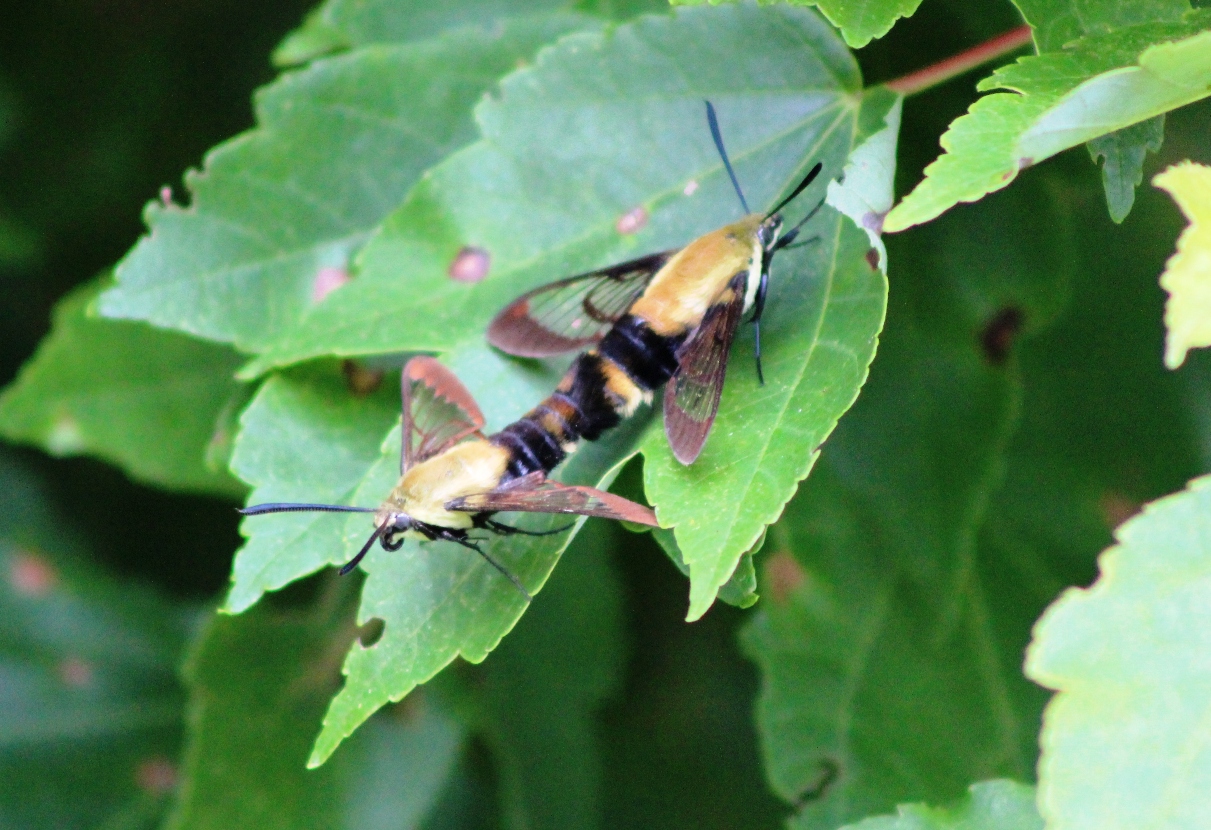
Hummingbird moths mating.


We have all seen tadpoles before, but in a bird bath, 20 inches off the ground?
 
With the exception of my tadpole bird bath, honey bees occupy every water source throughout my yard. Last time I found honey bees drinking water I discovered a swarm.  See Dec. 2, 2014 post.


A wheel bug consuming a Japanese beetle.  See Jan. 10 post for more wheel
bug information.

Ever seen a hummingbird's long tongue?  Many people assume they use their beak like a straw, but they actually lap nectar with their tongue, much like dogs lap water.
 
A plant gall.  Often caused by insects, most galls  are harmless to the plant.


Sunday, July 26, 2015

Counting Butterflies


               A large group of birders, naturalists, conservationists, photographers and other good people gathered for the Environmental Studies on the Piedmont’s 20th Annual Butterfly Count at the Clifton Farm Field Station in Warrenton, Virginia.  Several groups surveyed about ten different sites for the count, which contributes data to a nationwide study compiled by the North American Butterfly Association. 

                Local butterfly counts are a key component of a larger research effort to monitor  butterfly populations for changes that may be affected by weather, habitat change or other issues that impact the health of a butterfly species.  Sure, butterflies are pretty, help pollinate plants and are part of the food chain, but why are the numbers so important?  Twenty-two species in the U.S. are listed as threatened or endangered. The Xerces blue disappeared from California several years ago.  Last year two butterfly species in Florida were declared extinct by the U.S Fish and Wildlife Service.  The monarch population has decreased nearly 90% over a twenty year period.  Who knows, if we can save the butterflies, maybe we can save ourselves.
 
A dry, hot day in July was ideal for hunting butterflies.
 
Among the many butterflies and skippers we saw, there were plenty of tiger swallowtails.
 
We spotted a few red admirals.
 
Spicebusg swallowtails showed up for the count.
 

It was exciting to see some monarchs. 
 
Some participants tallied numbers and compared notes at the end of the day.

Monday, July 13, 2015

Butterfly Gardening -- Easy and Rewarding


Joe-Pye weed is a native plant and a butterfly favorite.


When you are purchasing plants for garden beds or containers, consider planting a tasty treat to attract butterflies.  With select plant choices and very little effort, you can host a butterfly buffet and enjoy watching the colorful activity all summer long. 

            Butterfly gardens need full sun.  For best results, plant en masse, with groupings instead of a scattered variety of plants.  Imagine what your garden looks like from the above.  Instead of planting one coneflower, plant a grouping of them, with another grouping of perennials next to that.  Planting en masse gives the same impact as color blocking in floral design.  You should also select a combination of plants to provide blooms all summer long and into the fall. Adding annuals along with your perennials can help achieve extended bloom time. 

            There are two ways to attract butterflies.  One is to simply offer nectar plants to feed adult butterflies.  The other is to add host plants to the mix.  These are the plants that butterflies lay their eggs on as a food source for the caterpillars.   Butterflies lay eggs on host specific plants.  The monarch caterpillars may defoliate your milkweed plant, but they won’t chew on anything else in your garden.  Avoid the use of  pesticides in your butterfly garden.  Chemicals that kill unwanted pests can kill butterflies and caterpillars too.  Native plants are always a smart choice.  Here is a list of the best plants to attract butterflies.

Nectar plants to attract butterflies:
A Common Buckeye on a coneflowe.r
 

Coneflower

Tall Verbena

Lantana

Butterfly Bush

Milkweed
 
Aster

Sunflower

Zinnia
A Monarch on lantana.
 
Joe-Pye-weed

Homestead verbena

Monarda/bee balm


Host plants for caterpillars:

Artmesisia       (host plant for the American Lady)

Coneflower     (Silvery Checkerspot)

Dill                   (Eastern Black Swallowtail)

Fennel             (Eastern Black Swallowtail)

A Monarch caterpillar eating milkweed.
Milkweed        (Monarch, Queen)

Snapdragon     (Common Buckeye)

Hollyhock        (Painted Lady)

Passion Vine    (Variegated Fritillary)

If you plant dill or fennel in your herb garden for use in cooking, consider planting a few extra to share with the beautiful Eastern Black Swallowtail caterpillars.  If you want to attract Monarchs with milkweed, purchase plants from your nursery.  Do not introduce wild milkweed into your garden because it is very invasive.   If you plant passion vine, give it plenty of room because it grows rapidly.  Some butterflies rely on larger host plants that you may already have in your yard.  The Tiger Swallowtail butterfly lays eggs on Sweet Bay Magnolias and Tulip Poplars.  Viceroys and Red Spotted Purples lay their eggs on willow trees. 

One of the most useful books about butterflies and habitat gardening for butterflies is The Life Cycle of Butterflies by Burris and Richards.

Wednesday, July 1, 2015

Why I Love My Meadow


                Three years ago when we moved from a neighborhood to the country, I was excited about having a little more green space around me.  The house we bought was seven years old and had a nice, established lawn.  However, the area beyond the manicured back yard, a space less than an acre, was a scruffy hill of weeds that the previous owners kept mowed.  It had no irrigation and only the toughest weeds grew there.  The ground was rock hard, and rocky.  And believe it or not, I was excited about that weedy, scruffy space on the hill.  Because I wanted a meadow.

                Today, because of agriculture and America’s love of lawns, we have less than one percent of native grasslands left.  It takes only one acre of natural grasslands to reintroduce ground breeding birds such as quail and meadowlark, birds that benefit from the protection of tall grass.   

                One benefit of having a meadow is that it needs no irrigation (think present day California) and unlike a lawn, it needs no fertilizer, which is a benefit to the Chesapeake Bay.  Plus, pollinators, birds and wildlife benefit from a meadow habitat, unlike your grass lawn that has nothing to offer nature.  A meadow is easier work than a lawn, but is not completely maintenance free.  Without mowing or a controlled burn each year, an unmaintained  meadow will revert to forest in a relatively short amount of time.  First cedar trees appear and then oak, pine and others soon follow. 

                To create a meadow, you must eliminate the weeds and cool season grasses present before replanting.  I used vats of Round-Up but the weeds basically rejected my efforts.  I don’t have a tiller, plus my meadow is on a slope, so after mowing it very short, I got to work with a hoe and a rake and did my best to loosen the soil. It took about two weeks of serious labor in early spring to prepare my meadow.  Although it seemed like most of the weeds were gone, apparently the weeds and Bermuda grass were just biding their time before returning with a vengeance.  Finally, I raked an area, planted seeds, raked another area, planted seeds, and so on, walking over each planted area to press the seeds firmly into the soil.  Each area I raked produced a mound a river rock from just beneath the surface. 

                This is my third year planting my meadow and fortunately I learned in a recent meadow class at the community college that it takes about three years for a meadow to become firmly established.  I also learned that a meadow shouldn’t be all about flowers – a proper meadow is a balance of 60 percent grass and 40 percent flowers.  Recommended grasses are a combination of little blue stem, big blue stem, switch grass and Indian grass.  Bermuda grass and crab grass don’t count.  This year, I am closer to the recommended mix but still have way too many weeds, despite additional vats of Round-Up. 

                I also learned that the recommended flower selection includes natives such as coneflower, aster, mistflower, Joe-pye-weed, liatris, brown-eyed Susan, goldenrod, and ironweed. (I learned this in the class that was offered soon after I finished planting this year’s meadow.)  I purchased seeds on-line by the quarter-pound, half-pound and pound, and probably over-seeded my space.  My rationale for over-seeding was that planting on a hill, some seeds would be washed away in a heavy rain.  The native flowers I chose were: coneflower, white yarrow, coreopsis, monarda, liatris, brown-eyed Susan, milkweed, cosmos and a native sunflower.  Then I broke the rules --  I planted non-native seeds as well.  I planted about a pound of zinnias, because butterflies and gold finches LOVE them.  I also planted tall verbena for the butterflies and because it reseeds easily.   I planted a little dill and parsley to feed black swallowtail caterpillars, but I think it may be too dry for them to succeed.  Next year I will add mistflower and aster to my selection.

                With the expense of bulk seeds and Round-Up, and all of the hard labor preparing the soil and fighting a losing battle with Bermuda grass, why do I bother?  Because I love my meadow.  It is so full of life.  There is a wide variety of bees and pollinators and insects.  The place literally buzzes.  It is also full of butterflies all summer long.  Great spangled fritillaries, tiger swallowtails, zebra swallowtails.  pipevines, painted ladies, silvery checkerspots, eastern black swallowtails and lots of skippers.  I am on the lookout for monarchs but sadly I haven't spotted any yet this year, although milkweed awaits them.  My meadow is full of grasshoppers, lizards and dragonflies.  Several times I’ve seen turkeys in my meadow.  Even a darn groundhog lives there.  When I walk out to my meadow, dozens of goldfinch take off in flight.  They love eating the seeds from the zinnias.  At dusk I watch flycatchers and gnatcatchers darting about, low over the meadow, eating insects.

                My meadow may not be a proper meadow.  My skills may be sorely lacking.  I don’t have any power equipment except a mower.  The crappie grasses are wearing me down.  And still, I love my meadow.  I love the diversity of life it supports.  I love that it succeeds only on rainwater.  I love the butterflies, dragonflies and gold finch.  I love the turkeys.  And I don’t dislike the groundhog. 


Unlike a lawn, a meadow has much to offer pollinators.
 
 
This zebra swallowtail sips nectar from milkweed.
 

Most butterflies, like the tiger swallowtail, enjoy the tall verbena in my meadow.


Dragonflies patrol the meadow's edge looking for insects.

You can't pick zinnias after gold finch have been feeding in the meadow.


Native plants, zinnias, grass and weeds.

 
I have seen a bumbper crop of great spangled fritillaries this year.

Many insects are attracted to native yarrow.

A pearl crescent sips nectar from a coreopsis flower.


Friday, June 26, 2015

A Walk on the High Side in NYC


                Central Park has always been a beautiful place to walk in New York City, but now there is the amazing High Line trail, which has taken the rails-to-trails linear park concept to a new level.  It started out as an abandoned, overgrown railway line above Manhattan’s lower west side, and is now a popular, landscaped park filled with water features, benches, trees and magnificent views. The park, which is 30 feet high and 1.5 miles long,  features 11 entry points, many of which are handicapped accessible. 
 

Street views and water views abound


Native plants and mature trees fill the walkway


The walkway is a very popular site

Thursday, June 18, 2015

Tachinid Fly - Another Parasitoid


           Tachinid Flies are members of the larger fly family Diptera. As adults, these spiky insects can be found on flowers, drinking nectar.  The female lays her eggs on or very close to a caterpillar.  When the eggs hatch, the larvae feed on the caterpillar.  The host slowly dies as the larvae continue to feed, grow and prepare to pupate.  They pupate underground and emerge as adults, ready to visit flowers and sip nectar.  If a Tachinid Fly parasitizes a moth caterpillar, well, that is part of the circle of life.  However, some Tachinid Flies parasitize butterfly caterpillars, including the monarch. That makes them nasty, vicious little bugs. 

Wednesday, June 3, 2015

Keeping a Watchful Eye on Birds


A Hooded Warbler is ready for release.
            They slip out under cover of darkness.  Clothed to combat the outdoor extremes, wearing mud boots and heavily loaded with tools and gear, they quietly move deep into the woods around four a.m.  By five a.m., the women have set up their operations and begun their work. They are dedicated bird banders, and recently I was fortunate to join them.
            Each summer for nearly 10 years, a group of volunteers has gathered in Powhatan County, Virginia,  to collect data for MAPS -- Monitoring Avian Productivity and Survivorship, a study conducted by The Institute for Bird Populations to monitor breeding bird populations. The institute studies the effects of land management, climate change and other ecological factors that influence bird populations. Researchers operate under a federal permit and are specially trained and certified.  On the day of my visit, there were three certified and experienced bird banders in the group.  Others, members of Richmond Audubon Society and James River Master Naturalists,  assisted by recording data and helping to manage the overall operation. 
            Research takes place for eight sessions during breeding season, from May to August, from 4 a.m. until noon.  Birds are caught in numerous soft nets in the woods near a lake at the Powhatan County Wildlife Management Area.  Nets are checked regularly and birds processed promptly.  Birds removed from the nets are placed in drawstring bags and brought to the work station.  Once examined and banded, they are quickly set free, unharmed.  Since many birds are females with broods to attend, they mustn’t be kept from the nest for long.  In addition to banding birds, the group collects and records data on age, sex, weight, condition and reproductive status.  Capturing previously banded birds enables researchers to track survival, reproductive rates and movement patterns.
            The work station consists of two picnic tables covered with tools, clipboards, measuring devices, scales, banding equipment, magnifying glasses, reading glasses, research manuals, books, and snacks. White-eyed Vireos, Wood Thrushes, Kentucky Warblers, Ovenbirds, Hooded Warblers, Titmice and other birds were among those I saw netted and banded.  Unlike birds that visit backyard birdfeeders, many migratory birds are not often visible because they live high in the tree canopy in densely wooded areas.
            America’s first bird conservation efforts began around the turn of the century in response to reckless practices in the 1800s which led to the extinction of several bird species, and also as a response to the slaughter of shorebirds to collect feathers for the millinery trade.  According to the Cornell Laboratory of Ornithology at Cornell University, at least six species of birds in North America are extinct.
            Once the most abundant birds in North America, Passenger Pigeons no long exist. The birds were no match for man’s efforts to shoot or net, transport and serve up a cheap, tasty meal of the birds.  Nesting in large colonies made them an easy target, and breeding nests were destroyed along with adult birds.
            Beautifully colored Carolina Parakeets, North America’s only parrot, were deemed an agricultural pest in the 1800s and shot by farmers.  On top of that, the bird’s colorful feathers were in demand by the millinery business to accent women’s hats.  Thanks to the paintings of John James Audubon, we have images of the beautiful birds we will never see in life.
            The Labrador Duck is extinct.  The Eskimo Curlew, the Ivory-billed Woodpecker (the largest woodpecker in the world) and the Bachman’s Warbler are believed to be extinct, according to Cornell, and none have been spotted for many years.         
            While one group of volunteers quietly and efficiently goes about the  business of monitoring and recording bird data in the hot, buggy woods each summer, we should be grateful for their dedication, along with others like them, especially given our nation’s avian history prior to such conservation  efforts.   
Kentucky Warbler


Measuring a Black and White Warbler
 
Tools for measuring, weighing and examining birds